Our dear Wale
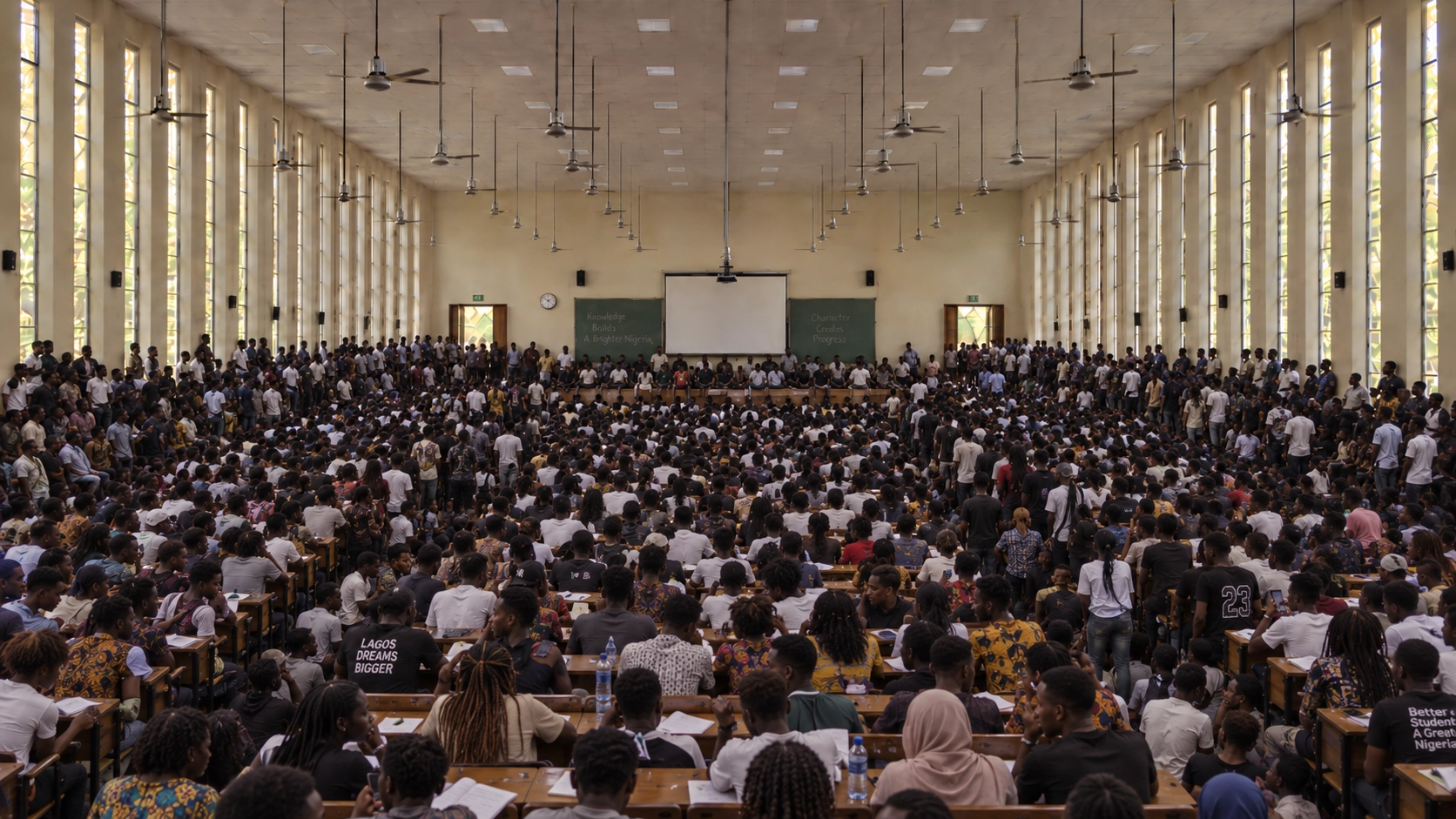
When lectures resumed fully in November 2013 at the University of Ilorin, I was fresher than a fresher—eager to learn, with zero pride and zero ego. The classes were always overpopulated: seats filled up before lectures started, and the walking partitions between each column of seats—and the partitions between the side walls of the class—were also filled with students either standing or sitting, trying to hear the ongoing lecture and write notes, if possible. Some of us were carefree enough to sit on the podium, literally at the lecturer’s feet. Wale was one of us.
Adekunle Yusuf Adewale was born and brought up in Mushin, Lagos State. He definitely didn’t look the part with his lanky frame, but he would tell everyone who cared to know how rough he grew up—how he jumped danfo buses to get around, how he could get hot pounded yam on his street by 11 p.m., how he dodged inter-school fights whenever they came up, etc.
We built a rapport by sharing notes, clarifying lecturers’ statements, and getting updates about the required departmental and faculty registrations. I found him to be particularly brilliant, especially with maths and any other science topic that had to do with calculation. He was always eager to learn and to teach; deriving formulae was his forte. I can’t remember how many times he said, “I can prove this formula—let me prove it for you,” after which he’d proceed to bring out his long “Higher Education” note from the one-hand bag he wore on his shoulder and derive the formulae step by step. The joy on his face when he arrived at the final state of the formula was always palpable. He even did a victory dance sometimes.
If he encountered problems he couldn’t solve, trust him to come back the next day saying, “I can solve it—let me teach you,” “I know how they got this formula,” or something of that sort. In our second year in school, he was tutoring a penultimate student in statistics. At the time, statistics wasn’t one of our courses, but he would go to the library to read the topics and then teach the person—just because he could. Unlike me, he was such a big fan of the library. He had favourite books and, when he couldn’t find them on the shelves where they were supposed to be, he would check every other shelf and the reading tables. It was common practice for some students to put a book in a completely unrelated shelf so they could always access it when needed. He would find the book and return it to its rightful place, or sometimes enter a pact with the anonymous reader and return it to the obscure place for easy access at other times.
One very fond memory I have of him was when we were hanging out at Block 7. He was trying to charge the Android tablet given to us by the school, Unilorin. The socket he plugged the tablet into wasn’t properly grounded, so he was being mildly electrocuted, but he couldn’t drop the tablet, as it was very fragile. He just danced and fidgeted until he was able to carefully drop it on the table. We both burst into laughter after he dropped it successfully 🤣. The tab was super precious to him, and he treated it like an egg. I doubt he ever had to repair it, as most of us did. Even when the screen protector had fallen off almost halfway, he never removed it; he just always told us, “Yes, leave it like that” 😁.
Another fond memory I have of him was his chess book. He had this phase where he got so interested in chess that he bought a “Higher Education” and hand-wrote and drew the moves for all the different chess openings he could find, along with the special rules like castling and en passant. He would try the moves while playing chess on the tablet, and whenever he needed someone to try it against, I was the scapegoat. Despite his claim of being baptised by the street, he was so gentle and kind, and so contented with what he had.
Isaac and I once put his ruggedity to the test when we decided to walk home from school (University of Ilorin to Unity, for those that are familiar with Ilorin), a distance of about 15 kilometres. He stopped halfway and boarded a taxi home after getting exhausted. He vowed never to try that again the next time we met, while still recovering from the journey. I got to see him weak a few times later on; we went to the school clinic together a few times when he fell ill. An occurrence that stuck with me during one of our visits to the clinic was when a doctor refused to attend to another student on the queue who was complaining of severe stomach ache. The reason was, in the doctor’s words, “He wasn’t bleeding or vomiting, so it wasn’t an emergency; and besides, it was time to attend to staff, and not students.”
I can’t remember which semester it was, but during one of the mid-semester breaks, he fell seriously ill and couldn’t resume on time—until several weeks into the semester, after tests had been written. He got better and came back to school but struggled to keep up, having to reschedule his tests; I think he even had to unregister a course to take at a later time. His grades tanked, understandably so, and his excitement about learning also reduced. He had to enter survival mode. He did survive the semester and went home for the break. At this time, his family had relocated to Ogun State.
That was his last semester in school. I was at home when Brother Abdulwasiu called me to inform me of his death. I was shattered and couldn’t hold back the tears. I was told he died after falling ill.
I was too timid to travel to attend his burial, but some of our classmates did, and I sent his Engineering Mathematics textbook through them to his family. It is customary in Islam for the family to settle debts owed to the deceased and debts owed by the deceased, and I felt the textbook was one of the debts I owed to him. His family, however, returned the textbook back to me, and I have it till this day.
I haven’t lost anyone as close as he was to me, and when it happened, I thought I would never forget him. However, if I’m being honest with myself, the details are becoming blurry, and I go months without remembering him sometimes. I had to write this to preserve what I have left of his memory. I couldn’t even remember the date he died when writing this, but I remembered it coincided with a classmate’s birthday—so I checked the classmate’s birthday on Facebook in order to remember. When I checked, it looked like a completely different date, so I’m not going to add that.
May Allah admit Yusuf into Aljannatul Firdaus and overlook his misdeeds. Aameen.
May Allah reunite us in Aljannatul Firdaus. Aameen.
— For Adekunle Adewale Yusuf